
What makes a hotel feel like a sanctuary
A great hotel is not the sum of its finishes. It is a sequence of moments, designed so a guest can exhale. Five principles we return to on every hospitality project.
Ask someone to describe a hotel they loved and they rarely mention the marble. They remember how it felt to arrive — the hush after the door closed, the light in the room at dusk, the sense that someone had thought about them before they got there. That feeling is not an accident. It is designed.
Across our hospitality work — from a 75-key hotel to a beachfront bar — we keep returning to the same principles. None of them are about luxury in the obvious sense. They are about choreography: arranging space, light and material so a guest can let their shoulders drop.
1. Design the arrival, not just the lobby
The most important room in a hotel is the one a guest passes through in twenty seconds. Arrival sets the emotional baseline for the entire stay. We design it as a decompression sequence — a narrowing, a threshold, a change in light and acoustics — so the noise of the journey falls away before the guest reaches the desk.
When the arrival is rushed or over-lit, no amount of beautiful guestroom can recover it. When it is calm, everything that follows feels generous.
2. Let the guestroom be quiet
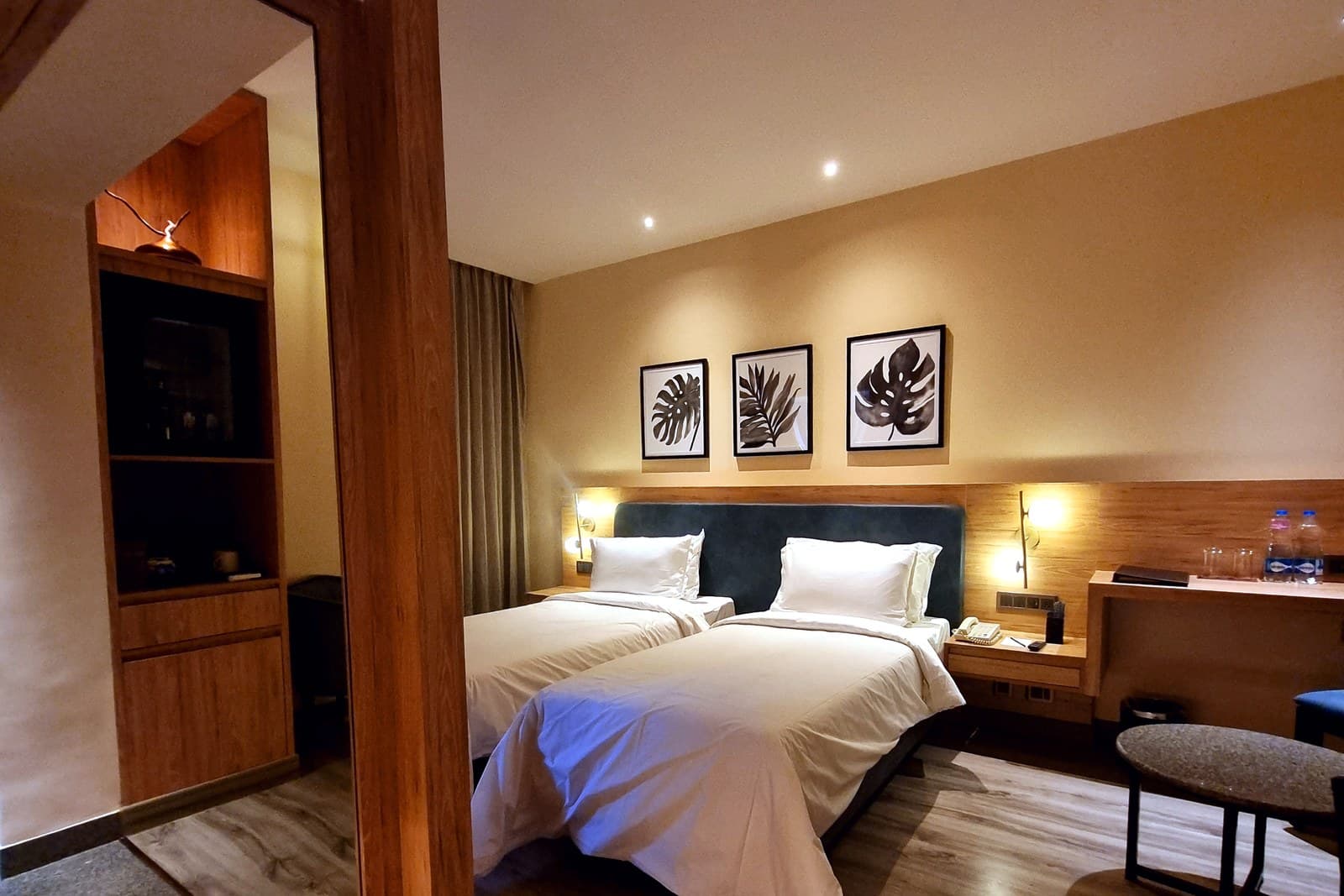
A guestroom is one of the few spaces a person occupies alone, often tired, often far from home. It should not try too hard. We resist the urge to fill it with statement pieces and instead invest in the things the body actually meets: the quality of the bed, the warmth of the lighting at 11pm, the absence of glare, the silence of the door.
Restraint here is not cost-cutting. It is respect for the guest's attention.
3. Build the layers of light
A single bright source flattens a room and exhausts the eye. We layer light the way a space is actually used — a wash for orientation, a pool for the desk, a low glow for the evening. Crucially, we give the guest control. The ability to dim a room is the ability to change how it feels, and that agency is part of hospitality.
“The ability to dim a room is the ability to change how it feels — and that agency is itself a form of hospitality.”
4. Choose materials that age with grace
Hotels are punished by use. Surfaces that look pristine in a render but scuff within a season betray the guest and the operator alike. We favour materials with honesty and patina — stone, timber, lime, aged metal — that absorb wear into character rather than damage.
A material that looks better after a thousand guests is a better material, full stop.
5. Remember the back of house
The guest never sees the service corridor, the laundry route or the staff break room — but they feel them. A hotel that is hard to run is a hotel that delivers a worse stay. We design the operational spine with the same care as the suites, because calm front-of-house begins with workable back-of-house.
Sanctuary, in the end, is a system. It is the architecture, the light, the materials and the operations all pulling in one direction: toward a guest who, for a few days, is genuinely at rest.